What Basketball Skills Should Players Develop at Each Age and Level?
Basketball development should not look the same for every player. A newer player may need hundreds of quality repetitions on basic footwork and ball control, while an experienced high school or college player may need more work on decision-making, pace, scoring reads, and executing skills against pressure.
That is why effective basketball lessons should match the player's current ability instead of simply giving everyone the same drills.
At Casey Teson Basketball Academy, we work with athletes from grades 4 through the college level and welcome different skill levels. The goal is to keep building the fundamentals while gradually increasing the speed, complexity, and decision-making required.
A player's grade can provide a useful starting point, but development is rarely perfectly linear. One player might be advanced as a shooter but still need foundational work with the weak hand. Another may handle the ball well but struggle with footwork or defensive positioning.

Skill Level Matters as Much as Age
Parents often ask what their child "should" be able to do at a particular age. There is no single checklist that fits every athlete.
USA Basketball's player development curriculum uses Introductory, Foundational, Advanced, and Performance levels and emphasizes progression based primarily on mastery of basketball and movement skills rather than age or grade alone.
That approach makes sense in practical training. Instead of rushing toward complicated moves, players benefit from strengthening the skills that support everything they will eventually do at higher levels.
Those skills usually include:
ball control with both hands
balanced shooting mechanics
passing and catching
footwork
finishing around the basket
defensive movement
understanding spacing
making decisions while moving
learning how to practice with purpose
The emphasis changes as players become more experienced.
Grades 4 And 5: Build Strong Basketball Fundamentals
For players in grades 4 and 5, developing control and confidence with basic basketball movements should usually come before learning a long collection of advanced moves.
This is an important stage for creating habits that will be used repeatedly later.
Ball Handling With Both Hands
Young players should become increasingly comfortable dribbling with either hand. The goal is not simply performing stationary dribbling tricks.
Players should work toward being able to:
control the ball without constantly looking down
change direction
change speed
protect the basketball
use the non-dominant hand
stop and start under control
A player who develops dependable ball control early has a stronger foundation for attacking defenders and making decisions later.
Basic Shooting Mechanics
Players at this level benefit from learning repeatable shooting habits rather than focusing only on making long-distance shots.
Balance, foot placement, hand position, alignment, and a consistent follow-through all matter.
Shot distance should not become more important than proper mechanics. If a player has to dramatically change the shooting motion just to reach the basket, practicing closer shots may provide better repetitions.
Passing And Catching
Passing sometimes receives less attention than scoring, but it is a fundamental basketball skill.
Players should practice delivering accurate passes, catching securely, passing while moving, and recognizing when a teammate is open.
Footwork
Good footwork supports almost every other skill.
Jump stops, pivots, changing direction, getting into a balanced shooting position, and moving defensively all become easier when a player learns to control the feet and body.
Grades 6 Through 8: Connect Individual Skills To Game Situations
Middle school players should continue improving fundamentals, but training can increasingly connect individual skills to realistic basketball situations.
The question begins changing from "Can you perform the move?" to "Can you recognize when and how to use it?"
Develop More Purposeful Ball Handling
Players can begin combining changes of direction, pace, body positioning, and attacking angles.
Instead of completing a predetermined dribbling sequence every time, athletes should learn to react to what a defender gives them.
That may involve recognizing:
an open driving lane
defensive pressure
space for a pull-up
when to change direction
when to protect the ball
when to pass instead of continuing the dribble
Add More Finishing Options
Finishing should expand beyond making a basic layup with the dominant hand.
Players can work on using either hand, approaching the basket from different angles, maintaining balance, and finishing after different types of footwork.
The objective is not collecting flashy moves. It is developing enough control to adjust when the path to the basket changes.
Improve Shooting Preparation
As players advance, what happens before the shot becomes increasingly important.
Footwork into the catch, balance, being ready to shoot, and getting the ball into the shooting motion efficiently can improve the quality of repetitions.
Players can also begin practicing shooting after basketball actions rather than only taking stationary shots.
Introduce More Decision-Making
Basketball is not a sequence of isolated drills.
Players eventually have to process defenders, teammates, space, time, and positioning at the same moment.
Game-like drills can help players learn to choose between attacking, passing, shooting, changing direction, or resetting the possession.
Grades 9 Through 12: Refine Skills At Game Speed
At the high school level, fundamentals still matter. The difference is that players increasingly need to execute those fundamentals at realistic speed and against greater defensive pressure.
Advanced players do not graduate from basic skills. They perform basic skills more efficiently.
Create Advantages Off The Dribble
Players should develop the ability to attack with purpose.
That can involve changing pace, using angles, protecting the ball, reading the defender's position, and getting to useful areas of the court without unnecessary dribbles.
Develop Shooting Consistency
High school players can work on producing a repeatable shot from situations they are likely to encounter.
Examples may include:
catch-and-shoot opportunities
shooting after movement
pull-up shots
shooting after a change of direction
relocating into open space
shooting under controlled defensive pressure
Quality matters more than randomly taking difficult shots.
Improve Decision-Making
As competition becomes more complex, recognizing what happens during a possession becomes increasingly valuable.
Players should work on seeing help defenders, recognizing passing opportunities, understanding spacing, and responding to ball-screen or driving situations when those concepts are appropriate for their development.
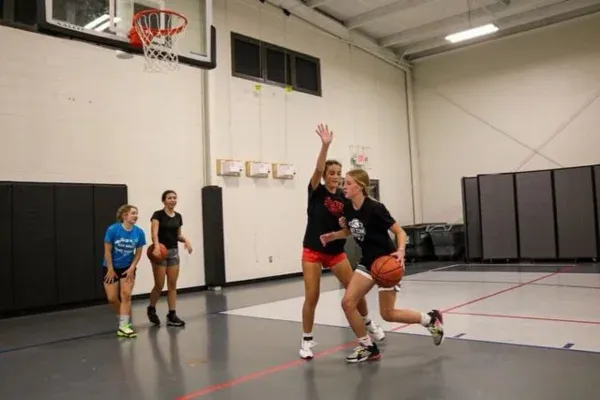
At Casey Teson Basketball Academy, group training includes game-like situations along with shooting, ball handling, finishing, and ball-screen work. (Teson Basketball)
Strengthen Defensive Fundamentals
Defense involves more than effort.
Players can develop better stance, positioning, lateral movement, closeout control, communication, and awareness away from the basketball.
Understanding where to be can become just as important as moving quickly.
College-Level Players: Make Skills More Efficient And Adaptable
College-level athletes generally need less introduction to basic basketball concepts and more refinement of how efficiently they execute them.
Small details become increasingly meaningful.
A player may work on:
creating separation with fewer movements
improving footwork before the shot
maintaining ball control against pressure
changing pace more effectively
finishing from difficult angles
making quicker reads
recognizing defensive rotations
improving position-specific skills
executing skills consistently at game speed
The objective is not necessarily adding more moves.
Often, higher-level development means becoming better at selecting the correct move and executing it with less wasted motion.
Beginners And Advanced Players Should Not Train Exactly The Same Way
Two athletes in the same grade may need completely different training priorities.
A beginner might need to focus primarily on dribbling control, passing, shooting mechanics, footwork, and basic defensive movement.
A more experienced athlete at the same age might benefit from applying those skills against pressure, processing multiple options, changing pace, and making quicker decisions.
This is one reason development should be progressive.
USA Basketball also notes that a player can be at different developmental levels for different skills. An athlete could have advanced ability in one area while still needing foundational development somewhere else.
Training should identify those differences rather than assuming every athlete progresses at exactly the same rate.
Basketball IQ Should Develop Alongside Physical Skills
A player can have excellent dribbling technique and still struggle during games if they do not understand what to do with the basketball.
Basketball IQ develops through situations that require observation and decision-making.
Players can learn to recognize:
where open space exists
when a driving lane is available
when help defense is coming
when a teammate has an advantage
when to move without the ball
when to slow down instead of attacking immediately
This is why game-like repetitions become increasingly important as athletes develop.
A drill can teach technique. A decision-based drill asks the athlete to apply that technique at the correct moment.
Confidence Usually Comes From Preparation
Confidence is sometimes treated as something players either have or do not have.
In practice, preparation can play a major role.
A player who repeatedly works on a skill, receives useful feedback, corrects mistakes, and eventually performs that skill in more challenging situations has evidence that the skill can work.
Instead of telling an athlete simply to "be confident," development should give the athlete something to trust.
That may be hundreds of thoughtful repetitions, improved footwork, better ball control, or becoming more comfortable making decisions under pressure.
How Often Should Players Practice Basketball Skills?
There is no universal schedule that works for every athlete.
School commitments, team practices, games, other sports, physical development, experience, and recovery all affect how much additional training makes sense.
More training is not automatically better training.
Short, focused practice can sometimes be more productive than a long session filled with careless repetitions.
Players practicing independently can choose a limited number of priorities for each workout. For example, one session might emphasize weak-hand ball handling and finishing, while another focuses more heavily on shooting footwork.
Consistency over time matters more than trying to master everything during one workout.
Useful Basketball Development Resources For Players And Parents
Players and parents who want to understand basketball development more deeply can use several reputable non-competing resources.
USA Basketball Player Development Curriculum
The USA Basketball Player Development Curriculum provides a progression framework built around different levels of skill development. It is especially useful for understanding why players should progress according to mastery rather than simply their age.NFHS Basketball Resources
Players entering or competing at the high school level can explore the NFHS Basketball Resources for official high school basketball rules, court information, and other educational materials.
Wilson Basketballs
Players looking for basketballs designed for different surfaces and training situations can compare options through Wilson Basketballs. Choosing an appropriate basketball for the playing surface can make independent practice more practical. (Wilson Sporting Goods)
SKLZ Basketball Training Equipment
The SKLZ Basketball Equipment collection includes training accessories related to areas such as shooting, dribbling, passing, and ball control. Training aids are optional, and players can still make meaningful progress through purposeful practice with basic equipment. (SKLZ US)
What Parents Should Look For In Basketball Development
Parents do not need to evaluate development only by points scored or games won.
Look for signs that the athlete is gradually becoming more capable and independent.
That might include:
using both hands more comfortably
making better decisions with the ball
shooting with more consistent mechanics
maintaining balance when finishing
understanding spacing better
communicating more on defense
recognizing mistakes and correcting them
practicing with greater purpose
Progress will not always happen in a straight line.
Competition level, physical growth, confidence, playing experience, effort, and consistency can all influence how quickly different skills develop.
Frequently Asked Questions About Basketball Skill Development
What ages and skill levels do you work with?
We work with basketball players from grades 4 through college, including beginner, intermediate, and advanced athletes. Our basketball program is built around each player’s current skill level, ability, and goals.
Because players develop at different speeds, training sessions are formed based on what each person needs most. One child may need more help with dribbling and ball control, while another may be aiming to improve shooting, passing, footwork, or game decisions.
Our coaches focus on teaching strong basketball fundamentals while helping kids and older players build confidence, communication, teamwork, leadership, and sportsmanship. Families are welcome to contact us if they are unsure whether their player’s age, grade, or experience is a good fit.
What basketball skills do you teach during training?
Our basketball training covers the essential skills players need to become more complete on the court. Training may include shooting, dribbling, passing, ball handling, finishing, footwork, agility, defensive movement, spacing, and game decision-making.
Skill development changes as athletes improve. A beginner may spend more time learning control, balance, and basic fundamentals, while advanced basketball players may work on creating space, reading defenders, changing speed, and making faster decisions during the game.
Our basketball trainers use their playing and coaching expertise to make workouts challenging without making them confusing. The goal is to help each player understand not only how to perform a skill, but also when that skill matters during basketball games.
Do you offer private basketball lessons or group training?
Yes. Basketball lessons can provide more focused teaching for athletes who need extra attention in certain areas, while group training sessions give players opportunities to compete, communicate, and practice around other athletes.
Different programs can support different goals. Individual work may be more customized around one player’s shooting, dribbling, footwork, or other basketball skills. Group classes can add teamwork, competition, sportsmanship, and game-like situations.
The right choice depends on the player, the season, current team or league schedule, training goals, and availability. Parents can contact us to learn more about current basketball training options and which type of session may make the most sense.
How are your training sessions different from regular team practices?
Team practice usually has to prepare an entire team for games, plays, defense, and the season. Our training sessions can place more attention on individual development and the specific skills each athlete needs to improve.
A trainer or instructor may break down shooting mechanics, ball control, passing, footwork, agility, decision-making, or another part of the player’s game. Players can receive more repetitions and direct feedback than they may have time for during regular teams or league practice.
Our goal is to support the work athletes are already doing with their coaches. Basketball training does not replace teamwork or team practice. It gives players another place to develop their individual ability and become more confident when playing with their team.
Do you offer youth basketball programs for beginners?
Yes. Our youth basketball programs can support kids who are still learning the game as well as players who already have experience with teams, sports, clinics, or other programs.
For a beginner, we keep teaching clear and practical. Players may start with basic dribbling, passing, shooting, ball control, balance, and footwork before moving into more advanced basketball skills.
We want youth athletes to learn in a supportive environment where they can make mistakes, ask questions, practice, and continue improving. Fun also matters. Players are more likely to stay committed to development when they enjoy learning and feel excited to come back to the gym.
Parents can ask about classes, clinics, basketball lessons, and other options that fit their child’s current experience.
Where is the basketball training located, and do you serve the Chesterfield area?
Casey Teson Basketball Academy serves families looking for basketball training in the St. Louis area, including families from Kirkwood and the Chesterfield area.
Training location, gym availability, and specific programs may vary, so we recommend checking our website or contacting us before registration. This is also the best way to confirm current training sessions, court location, class times, and availability.
If your family is traveling from Chesterfield or another nearby St. Louis community, we can help you understand which basketball program, session, or location may be the most practical option.
How much does basketball training cost, and how does registration work?
Cost can depend on the type of basketball training, the length of the session, and whether the player is joining private basketball lessons, group classes, clinics, or another basketball program.
For the most accurate information about cost, registration, current programs, and availability, parents should contact Casey Teson Basketball Academy directly or visit the website. This also gives families a chance to ask questions before they join.
If a program requires payment, package information, scheduling, or account credit, those details can be explained before registration. We want families to understand what they are signing up for and what to expect from each training session.
Will basketball training help my child become a better player?
Basketball training can help when the player is willing to practice, listen to the instructor, and stay committed to learning. Improvement is usually built through consistent workouts, good teaching, useful feedback, and repeated practice over time.
Our basketball trainers focus on development rather than promising a certain number of points, a spot on a team, or a specific result. Every athlete develops differently, and progress can depend on age, skill level, playing experience, practice habits, season demands, and personal ability.
We aim to help basketball players improve their fundamentals, shooting, dribbling, passing, footwork, confidence, communication, leadership, respect, teamwork, and overall understanding of the game. Our dedicated coaches provide a supportive training environment while encouraging players to participate fully and take responsibility for their own development.
The goal is to help each athlete build skills they can use during practice, games, league play, and future basketball opportunities.

Keep Building The Right Skills At The Right Time
Basketball development works best as a progression.
Younger and newer players need a strong technical foundation. As athletes gain experience, those same fundamentals should be challenged through greater speed, defensive pressure, decision-making, and realistic game situations. College-level development often becomes even more detailed, with greater emphasis on efficiency, adaptability, and execution.
For families in Kirkwood looking for structured Basketball lessons, Casey Teson Basketball Academy works with athletes from grades 4 through college and across different skill levels. Our training focuses on basketball fundamentals and game development, including areas such as shooting, dribbling, footwork, decision-making, and game-like situations. To ask about training or find the right next step for your player, call (314) 873-5901 or Contact Us.